
Left Turn Motorcycle Accident Lawyer in Corpus Christi
The oncoming car turned across your lane, and 'I never saw the motorcycle' isn't an excuse a jury has to accept.
Get a FREE Case ReviewFree. No obligation. Takes about 2 minutes.
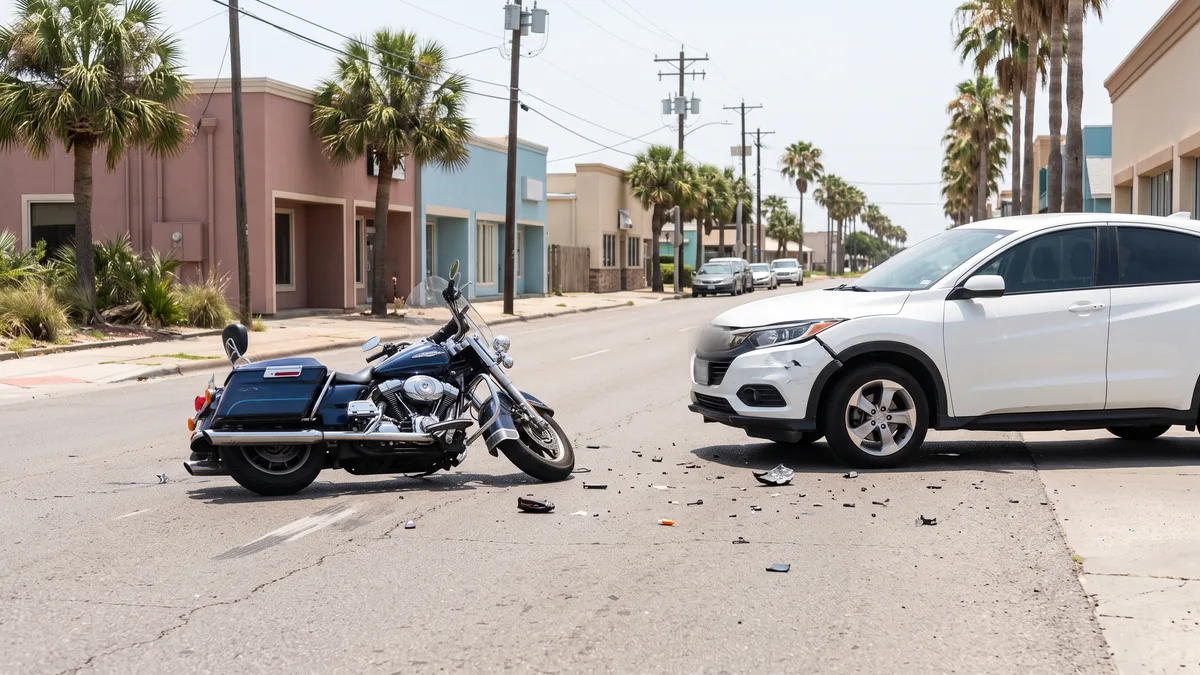
The car ahead sits at the intersection, waiting on its turn. Then it turns anyway, straight across your lane, right as you’re closing the gap with no room left to brake or swerve. “I never saw the motorcycle” is the sentence you’ll hear next, and it isn’t an excuse. It’s the driver telling you, in their own words, that they turned without actually checking.
Left turns are Texas’s most common motorcycle intersection wreck
Your crash fits a pattern TxDOT has already documented. Statewide in 2024, 40% of motorcycle rider deaths happened at or near an intersection, and a driver turning left across an oncoming lane is one of the biggest reasons why. A turning driver has to judge your speed and distance correctly before committing, and a rider on a motorcycle is easy to misjudge, or miss outright.
What the evidence actually has to show
Memory contests don’t decide these cases; physical evidence does. The crash report’s diagram marks where each vehicle sat when the dust settled, and rest positions alone can say a lot about who had the right of way. The angle and location of the impact damage tell a similar story, matched against how a turning car and a straight-moving motorcycle would actually collide. Nearby intersection cameras, business cameras, even a doorbell camera across the street, can settle the question outright if one exists. Independent witnesses, drivers stopped at the same light, round out the picture. Get a copy of the crash report early and read what it already captured.
When the insurer blames your speed instead
Expect the driver’s insurer to push back with a familiar move: claiming your speed, your lane position, or your riding style caused the wreck. Claims like that need proof, and adjusters often make them without any. Even a partial share of blame doesn’t shut a claim down; in Texas, it only stops once your share of fault crosses the halfway line. The guide on shared fault breaks down how a percentage like that actually shrinks a payout, and how proof pushes back on a number an adjuster hands you too early.
Why the injury list tends to grow, not shrink
Even at city speeds, a car turning into a rider’s path causes fractures, ligament damage, and injuries that end in surgery and long stretches of physical therapy. Some injuries don’t fully show themselves until weeks in, once the adrenaline wears off and the real recovery timeline sets in. That’s part of why settlement value has to account for care that hasn’t happened yet, not just the bills sitting on the table today.
The cameras won’t wait for any legal deadline
Footage that caught the turn gets erased on its own schedule, often within days, long before any court deadline comes close to mattering. If the report doesn’t already list which cameras were nearby, that’s worth asking about now, not months from now.
The story a driver tells right after a crash tends to be the one that sticks, fair or not. Getting your own version documented early, while the evidence still exists, is how that gets pushed back on.
Common questions
The insurance company is saying I was going too fast when the driver turned in front of me. Does that wreck my case?
Not by itself. Sharing some blame doesn't wipe out a Texas claim; the law only bars recovery for the party carrying most of the fault. What matters more is the proof behind either version of your speed, which usually comes down to the crash report, any camera footage nearby, and how the two vehicles came to rest.
The driver already got a failure-to-yield ticket. Is my case basically settled?
It helps, but it isn't the whole claim. A citation is a strong sign the officer thought the driver was at fault, but it doesn't set a dollar figure. Your claim still has to account for medical costs, lost income, and how serious your injuries turned out to be, none of which a ticket covers.
The driver had a green turn arrow. Does that change things?
It can shift the story in the driver's favor, since a protected arrow gives them the right of way. Even then, the physical evidence still has to back that version up: the impact angle, where both vehicles landed, and whatever any nearby camera picked up.
Related pages
Blind Spot Accident
A lane change into your motorcycle isn't an accident of geometry. It's a driver who didn't look, and the law says the lane was yours.
Learn more →Distracted Driving
Proof of a driver's distraction usually isn't a confession. It's a phone record, a camera angle, and a crash that never slowed down.
Learn more →Drunk Driving Accident
A drunk driver caused your crash. Your claim runs on its own terms, not the criminal case's timeline.
Learn more →Hit and Run
The driver who hit you kept going. Your claim didn't go with them.
Learn more →See if you have a case — free
Answer a few quick questions. If your case qualifies, an independent attorney who serves Corpus Christi can review it at no cost.
Get a FREE Case ReviewNo fees unless you win. No pressure to hire anyone.